
 Most dealership financial problems do not begin with catastrophe.
They begin with a feeling.
A feeling that cash is tighter than it should be.
That inventory is aging faster than the conversations in the manager meeting would suggest.
That floorplan interest somehow keeps climbing despite everyone insisting sales are “actually pretty good.”
That the bank is starting to ask more questions.
And that everyone inside the dealership is working very hard without anyone feeling completely in control.
This is usually the point where dealerships begin looking for solutions.
Sometimes they think they need:
- A stronger controller
- More office staff
- A better CPA
- Tighter expense controls
- Or someone to “help clean things up for a while.”
But in many cases, the real issue is not staffing.
It is visibility.
Because most dealerships do not actually have a structured financial oversight process.
What they have is a handful of hardworking people trying to manage increasingly complex financial pressure in real time while also answering emails about toner cartridges and broken printers.
The problem is not effort.
The problem is that the financial structure of the dealership has quietly become reactive instead of intentional.
And in uncertain markets, reactive operations eventually make lenders nervous.
You Can Usually Feel the Shift Before You Can Measure It
There is a particular point where the mood changes.
The floorplan statement starts getting opened more carefully.
The used inventory meeting becomes slightly more tense.
The lender requests additional reporting.
Someone mentions curtailments twice in one week.
The OEM business management team suddenly wants updated financials faster than usual.
Nobody panics immediately because dealerships are resilient places. The car business trains people to tolerate chaos at Olympic levels.
But underneath the resilience, something important starts happening:
Management begins making decisions emotionally instead of strategically.
Inventory gets held too long because nobody wants to take the loss.
Expenses remain untouched because “things should turn around soon.”
Cash forecasting becomes verbal instead of structured.
And the dealership slowly drifts into a cycle where surprises become normal.
Banks do not like surprises.
Neither do OEMs.
Most Dealerships Do Not Have a Cash Problem First
They have a forecasting problem first.
This is an important distinction.
By the time cash becomes visibly tight, the operational behaviors causing the pressure have usually been developing quietly and comfortably for months.
Aged inventory.
Shrinking grosses.
Higher flooring expense.
Slower receivables.
Weak expense discipline.
Delayed reactions.
Lack of forecasting cadence.
The dealership often does not need more data.
It needs better interpretation of the data it already has.
That is where structured financial oversight changes things.
Because without visibility, management tends to operate based on instinct, urgency, and optimism.
Optimism is valuable in sales.
Banks prefer math.
Aged Inventory Has a Way of Becoming Everyone’s Problem
Used inventory aging is one of the clearest examples of this.
At first, a few units drift past 60 days.
Then 75.
Then someone says:
We’re still making good grosses on those.
Which may technically be true in the same way someone can technically still wear their college jeans if they avoid sitting down.
Meanwhile, floorplan interest quietly expands in the background.
Curtailments begin approaching.
Liquidity tightens.
The lender notices.
Then the OEM notices.
Then everyone suddenly wants an aging report printed immediately as though the printer itself caused the problem.
This is where many dealerships mistakenly think they simply need tighter inventory management.
But the deeper issue is usually lack of financial structure around inventory decisions.
Questions like:
- What is the true cash exposure of this unit?
- What does this aging profile look like 30 days from now?
- What upcoming curtailments will this create?
- How does this affect covenant compliance?
- What is the carrying cost versus realistic exit strategy?
Those are financial oversight questions, not merely inventory questions.
Why This Is Not a Staffing Problem
This is also the point where many dealers begin searching for “controller help” or temporary accounting support.
And while additional help may absolutely be needed, staffing alone rarely solves the underlying issue.
Because the dealership’s challenge is often not transaction processing.
It is lack of strategic oversight.
There is a significant difference between:
- Processing accounting activity
- Reviewing historical statements
- And actively managing the financial direction of the dealership.
A controller may ensure transactions are accurate.
A CPA may review what already happened.
But structured CFO oversight focuses on:
- Forecasting
- Lender confidence
- Covenant visibility
- Cash planning
- Operational discipline
- Risk exposure
- And helping management make earlier decisions.
That difference matters tremendously in volatile markets.
Especially when lenders begin watching more closely.
Curtailments Are Where Optimism Meets Mathematics
Curtailments have a way of forcing uncomfortable realism into the conversation.
Because eventually the lender says:
We’ve financed this inventory long enough. We would now like some cash back.
That becomes difficult when the dealership needs the same cash for:
- Payroll
- Advertising
- Tax payments
- Facility expenses
- Or the espresso machine nobody remembers approving.
Without forecasting, curtailments often feel sudden and disruptive.
With structured financial oversight, they become manageable because they were anticipated weeks earlier.
That changes everything operationally.
The dealership can:
- Proactively adjust pricing
- Liquidate selected inventory strategically
- Prepare lender conversations early
- Forecast liquidity pressure
- And avoid emotional decision-making under stress.
The goal is not perfection.
The goal is removing surprise from the process.
Because surprise is expensive.
You May Already Be Seeing the Signs
Many dealerships experiencing financial strain do not initially recognize it as a visibility issue.
Instead, it feels like:
- Cash constantly feels tighter than expected
- Floorplan interest keeps climbing
- Forecasting only happens when there is pressure
- Inventory aging discussions keep getting delayed
- Month-end closes still take too long
- Managers are reacting instead of planning
- The bank is requesting more information
- OEM participation feels harder to maintain
- Or leadership simply feels mentally exhausted from uncertainty.
Those are rarely isolated problems.
They are usually symptoms of insufficient operational financial structure.
OEM Participation Depends on Financial Stability More Than Dealers Realize
Dealers sometimes think of lender relationships and OEM relationships separately.
But they are deeply connected.
Weak financial visibility eventually affects:
- Inventory strategy
- Facility planning
- Incentive participation
- Allocation confidence
- Audit exposure
- And overall operational consistency.
A dealership constantly scrambling for cash eventually struggles to operate proactively.
Everything becomes short-term.
That tension spreads everywhere.
Employees feel it.
Customers feel it.
Lenders definitely feel it.
And OEMs tend to become cautious when dealership operations appear financially unstable or unpredictable.
Consistent OEM program participation requires operational discipline.
Operational discipline requires visibility.
Visibility requires structure.
The Weekly Cash Dashboard That Changes the Conversation
One of the simplest but most effective changes is implementing a weekly cash dashboard.
Not a giant accounting spreadsheet nobody opens voluntarily.
A real operational visibility tool.
Something leadership can review quickly and consistently.
A simple version may include:
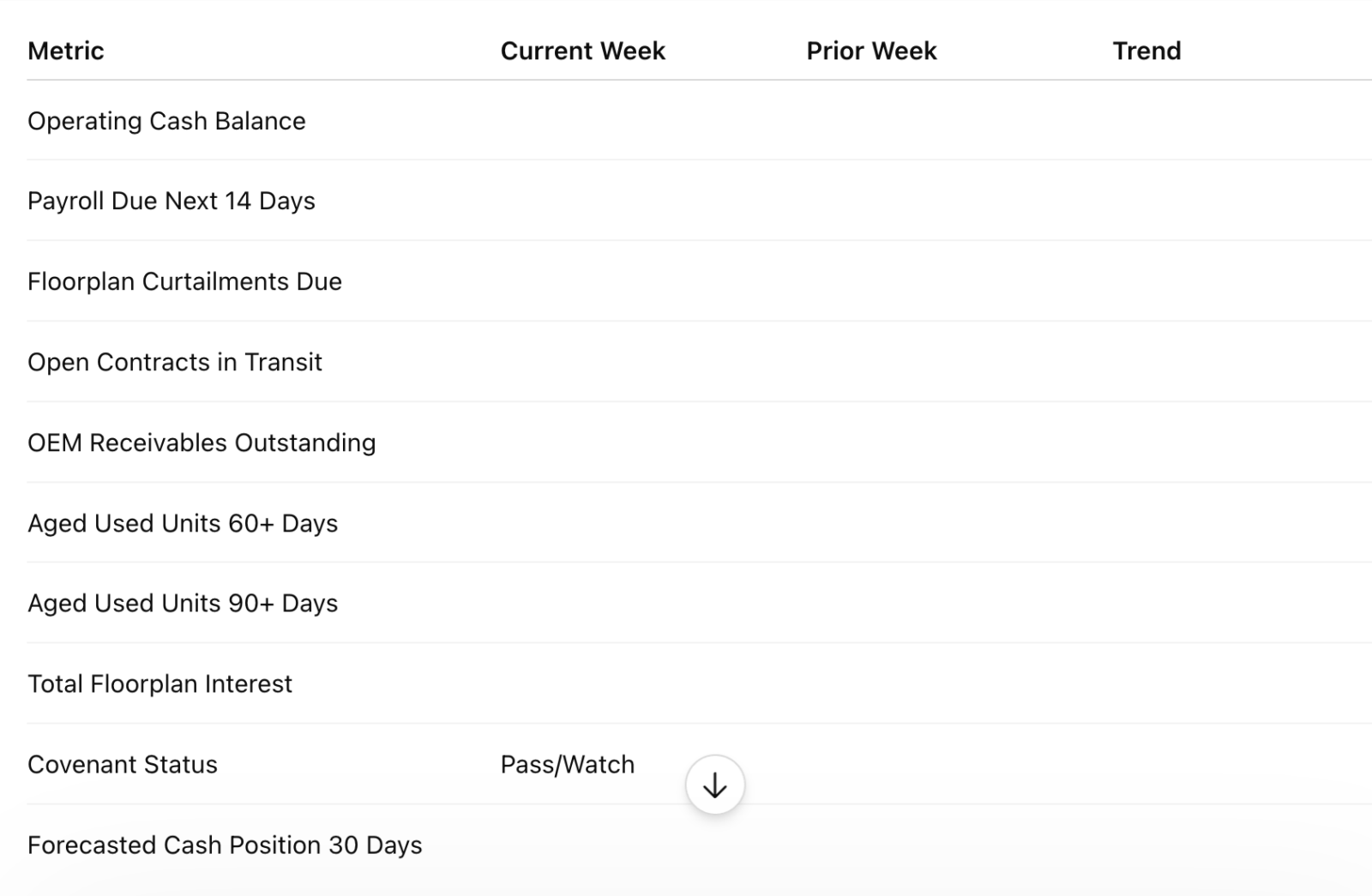
This is not about producing more reports.
It is about creating operational visibility early enough that leadership can make calm, strategic decisions instead of reactive ones.
That single shift changes lender conversations dramatically.
Because lenders become far more flexible when management appears informed, realistic, and proactive.
The Real Goal Is Emotional Stability Through Financial Visibility
There is a misconception that financial leadership only matters when a dealership is already in trouble.
In reality, the best operational financial oversight happens before the crisis.
- Before covenants become strained.
- Before curtailments create panic.
- Before cash conversations become emotional.
- Before the bank loses confidence.
Because dealerships rarely collapse from one dramatic event.
More often, they slowly drift into financial pressure without enough visibility to react early.
The goal is not simply cleaner statements.
Or tighter accounting.
Or more meetings.
The goal is operational calm.
A dealership where:
- Management understands the numbers
- Forecasting exists before pressure appears
- Inventory decisions are intentional
- Lenders remain confident
- OEM participation stays consistent
- And leadership is no longer operating in constant reaction mode.
That kind of visibility does not eliminate difficult markets.
But it changes how a dealership moves through them.
And in uncertain markets, calm operational leadership becomes a competitive advantage all by itself.
If you’re ready for executive-level financial oversight without adding headcount, let’s connect. Automotive CFO-To-Go™ is built for exactly this situation.